The ancestors of these primroses jumped into a plant pot in Wales and made a journey…
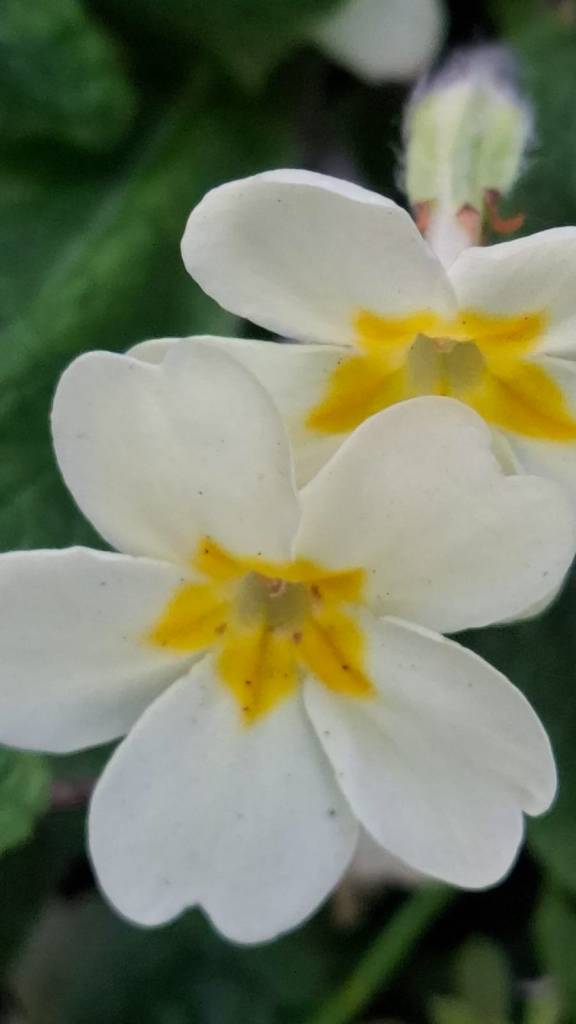
The last photos I took in March were of primroses: the results are a bit shaky: I’m a little out of practice. That’s OK because I’m prompted by Bushboy’s Last on the Card challenge. And as you may know, the idea is to post, unedited, whatever you discover you’ve taken.
I haven’t posted at all for some while, as my main focus has been on writing, and my current WIP eats up most of my writing time. The story plays out in a world bereft of natural pollinators, so this month, I couldn’t resist showing a photo of precious primroses: to see them thriving gives me hope.
These primroses are mine, in the sense that they are the offspring of flowers that seeded into a large plant pot when I lived in Wales. They moved with me when I came back to Dorset. I love their spontaneous beauty – and how they multiply!
They’ve been been flowering in my garden since before Christmas. They must be hardy as they came through the few frosts we’ve had without trouble. In general, they are usually at their peak from March to May. It’s all happening a little earlier, these years. Mine have spread from the original few and spring up wherever they can. Along the path is a favourite spot, but I find them in odd places, growing in hardly any soil, and sometimes pot them on to give away in the hope that they will spread. Perhaps someone else will pot on the extras and give those away too.
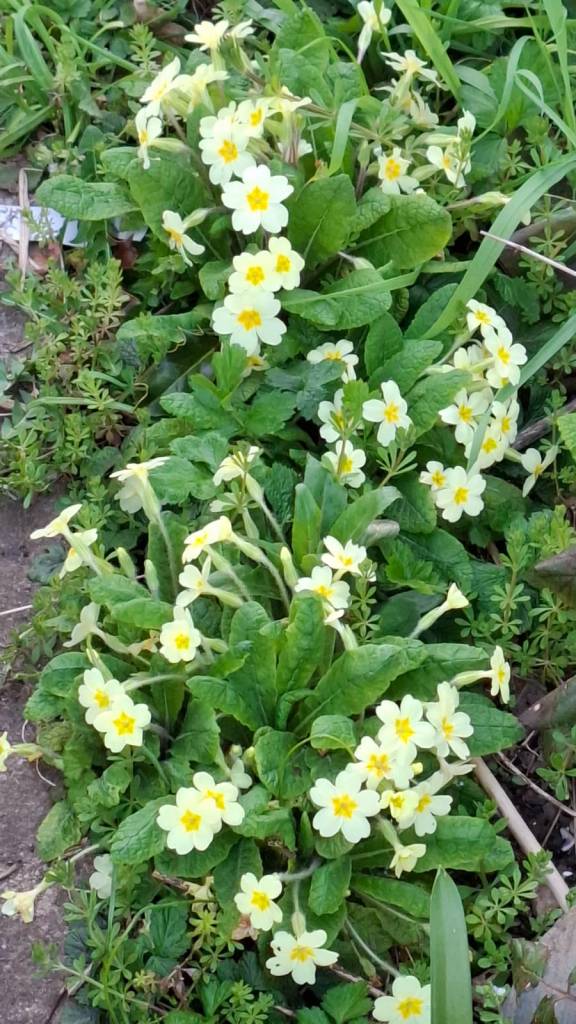
These ‘common’ primroses (Primula vulgaris) are native to the UK and although there are many, there could and perhaps ought to be more. I would love to see primroses everywhere – in shady woods, green verges and all over people’s lawns. Have one plant and more will follow.
We took a neighbour out to look at them in their abundance, on banks by the roadside and in a quiet churchyard. I noticed that some had a green spot in the middle and have since found out, through Wildilfe Gardening Forum and elsewhere, that there are supposed to be two kinds: ‘pin-eyed’ and ‘thrum-eyed’. Only one kind is found on each plant and this is an aid to cross-pollination. The green pin in the pin-eyed type is the stigma: it’s at the top of the flower tube, while the anthers are lower down. In the thrum-eyed it’s the other way around and the anthers look like an orange ring. Can you tell which sort I have photographed?
Apparently, there is another type that is self-pollinating. According to an article in the New Scientist these produce more, but smaller seeds and are less successful than the cross-pollinating types, which produce fewer, but bigger seeds. Perhaps in the future, we’ll be glad that there’s a self-pollinating type.
Primroses are a valuable early source of nectar for bee-flies, and butterflies such as brimstone and small tortoiseshell. I prefer the native primrose, but last year, somehow there was cross-breeding with something else, and a double variety spontaneously appeared. Pretty, but I was alarmed in case all my native ones disappeared. I didn’t need to worry. Given the right conditions and some healthy neglect, your garden can have them in abundance too.
So, unless your lawn is meant for croquet or bowls, why not plant a few common (spectacular!) primroses in a shady spot or in a patch of earth in a border or just in pots – and have the joy of seeing them spread? The countryside around me is green – but that’s mainly grass. Wherever we can, let’s nurture the wild flowers we have and see if we can have them in abundance again, and help nature’s pollinators too, on which we all depend.


Beautiful! And I’m excited to read more about your work in progress, Maria!
LikeLiked by 1 person
Thanks, Valeria. That’s very kind. I’ll keep going!
LikeLike
Hi Maria 👋 So good to see you and send me your beautiful Primroses.
What a classic last photo as well. Made me smile. I might pop into the nursery when I am in town next and see about Primroses, of course will be hybrids in Australia. The big patch looks so good and would match my ramshackle style of gardening.
Thanks for joining in 😀
LikeLiked by 1 person
Thanks, Brian! Ramshackle is good…I like that style 😁
LikeLiked by 1 person
cheers to your call for the wildflowers (have you ever heard the children’s book that involves the Lupine Lady scattering seeds?)
and I had no idea there were diffeent kinds of Primose – but I know it is one of my mother’s favorite oils….
LikeLiked by 1 person
That’s lovely, Yvette. I wonder if the primrose oil your mother likes is Evening Primrose? That’s the one that comes to mind for me…
LikeLiked by 1 person
you know, I think it is the Evening one – even though she is not taking it lately. But she used to take it regularly – right now – she takes coq10 and tumeric twice a day – and other supps and stuff – but I see her really fervent about those two –
LikeLiked by 1 person
It’s a lovely plant too and self seeds all over our allotment! Quite tall unlike the common primrose
LikeLiked by 1 person
How fun to keep learning bits about plants
LikeLiked by 1 person
here is the book your post reminded me of:
The story of the Lupine Lady is featured in the children’s picture book Miss Rumphius by Barbara Cooney, published in 1982. The book tells the tale of a young girl named Alice, who promises her grandfather that she will travel the world, live by the sea, and do something to make the world more beautiful. After her travels and a life as a librarian, Alice, now an older woman, decides to scatter lupine seeds across her community, transforming it with the vibrant flowers and earning her the nickname “The Lupine Lady.”
LikeLiked by 1 person
Thanks for telling us more about the story! Was it a true one? I’m tempted to try and find that book now.
LikeLiked by 1 person
I am not sure if it is based on a true story, but truly a fav of mine and I think I am going to go and get a copy for my step-daughter’s children (my two grandkids) because I liked the story so much
anyhow, sharing with you about this book reminded me of how much I LOVED children’s books when my children were small. I knew I liked them at the time, but now I see even more how much I enjoyed those books (likely more than they did – ha)
LikeLiked by 1 person
What a beauty! Such a cheerful yellow color💛
LikeLiked by 1 person
Thanks – they are gorgeous. Looking forward to them coming up in new places next year. Thanks for reading!
LikeLike
Hello – I hope you are having a nice 2025
and I enjoyed this primrose post – and learnng
“that there are supposed to be two kinds: ‘pin-eyed’ and ‘thrum-eyed’. Only one kind is found on each plant and this is an aid to cross-pollination”
🙂
LikeLiked by 1 person
Hi Yvette, it’s kind of you to drop in! I haven’t been blogging lately, but am getting on with writing a novel so that makes me happy. Also spending time with my dad, who is 93. He was completely independent until recently but we all need a little help some time. Hope things are going well with you… 🥰
LikeLiked by 1 person
☀️☀️☀️
LikeLiked by 1 person